Open Source Bug Tracker Template
File it, triage it, squash it.
A lightweight issue tracker: severity, status, filters, and a closed graveyard — for projects that don't need Jira.
This is the real app, not a mockup. Whatever you enter in the demo stays in your browser and belongs to nobody.
What you get
One zip. Everything to own it.
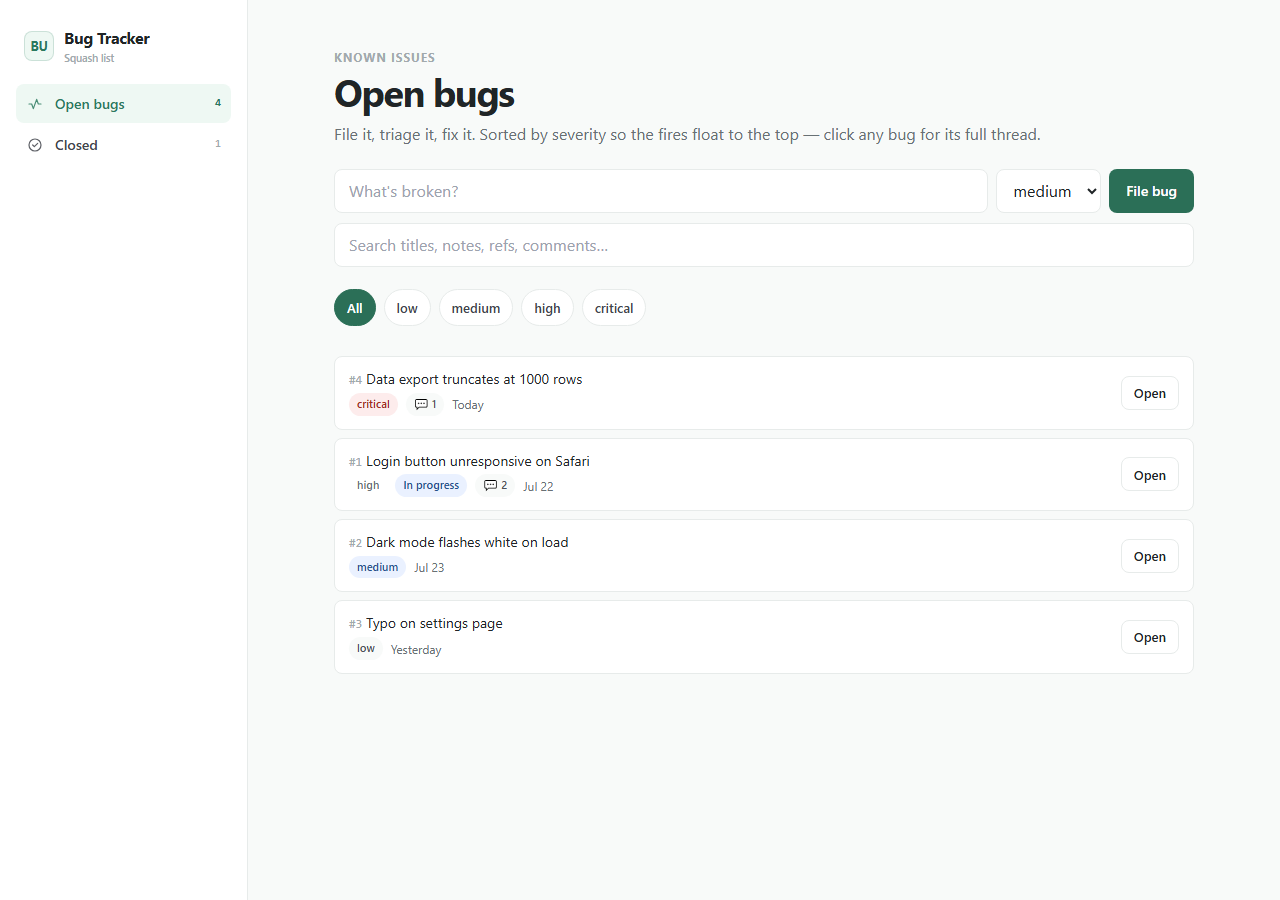
Bug Tracker is for the project that needs a list, not a platform. Bugs get a reference number, a severity, and a status; the open view sorts fires to the top, and closed bugs rest in the graveyard until they come back (they always come back). The single-file data model makes it a perfect base for adding assignees, labels, or a public roadmap.
- Reference numbers and severities
- Severity-sorted open view
- Open ? in-progress ? closed flow
- Severity filters
- Reopen ("it's back") flow
bug-tracker/├── app/the running Next.js app├── agent/START_HERE, PROJECT_MAP, RULES, RECIPES, TESTS, DEPLOY├── CLAUDE.mdread automatically by Claude Code├── AGENTS.mdread automatically by Codex├── .cursor/rules/loaded automatically by Cursor└── README.mdrun it, then make it yours
Inside the app
Customize with AI
Your agent already knows this codebase.
Ships with CLAUDE.md, AGENTS.md, Cursor rules, and a full agent handbook — project map, safety rules, recipes, tests, and deploy notes.
Prompts written against this app
Run it
5 min to your own copy.
- 01Create your editable app copy and unzip it.
- 02Run npm install.
- 03Run npm run dev and open http://localhost:3000.
- 04Read /agent/START_HERE.md before customizing.
- 05Swap the local-first storage boundary for your own backend when ready.
Bug Tracker data stays in this browser by default.
No account, backend, or cloud sync is included in the current package.
An agent can add optional sync later while preserving the local-first default.
This package is standard-ready for Create My App and AI customization.
A full app-only PWA install route is not enabled yet for this app.
If this isn’t quite right
Take Bug Tracker and make it yours.
Free, MIT, 5 min to running. The demo above is exactly what lands in your folder.